
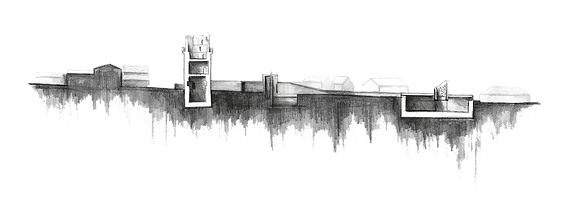
Preston Tower and its dovecot and walled garden can be considered as a gap in the otherwise developing urban fabric. Central to this idea is the progressive encroachment of the town on the site, and the developing programmatic disconnect between the tower and the town- largely due to the decline of craft and cottage industries. Key moments from Prestonpans industrial heritage might include coastal trades such as oyster farming and fishing; manufacturing industries such as a glassworks, brickworks and colliery; as well as the (once imposing but now demolished) Cockenzie power station. All of these have since vanished; today’s industry bears no relation to the ruin.
The programmatic proposition sought to revitalise this ruin through the creation of a new industrial story- choosing to focus on the delicate qualities of glass as a counterpoint to the massive, stereotomic qualities of stone by proposing a new craft glassworkshop. Popular treasure-hunt app, Geocaching, is utilised as a strategy for reconnecting to industrial heritage. The new glassworks acts as a base from which to run the Geocache boxes which players search for. The tower itself is the final part of Prestonpans’ Geocaching network.

REDISCOVERING HISTORY THROUGH GEOCACHING || TOWER AS CENTREPOINT

COMMUNITY GLASSWORKS
MA(Hons) 4th Year Design Project || Heritage and New Industry
[IN COLLABORATION WITH JOHN ALLCOCK & RICHARD THOMSON]
CREATING A JOURNEY // TECTONIC LANGUAGE
PASSIVE AND ACTIVE INTERACTION, CULMINATING IN DIFFERENT EXPERIENCES OF SPACE
Development at both an architectural and technical level built upon the initial proposition for a craft glassworkshop within the walled garden. The design process sought to use all scales to EMPHASISE THE JOURNEY through the process of glass working. The urban design strategy strove to realise the conceptual
pedestrian paths between the varying parts of Prestonpans’ industrial heritage. Thus, the journey through the glassworks itself offered a climatic, logical sequel to this journey through the town. Here the architecture guides visitors from the history of industry and glassmaking into the cold workshop. The transition to the ‘sacred’ hot workshop is emphasised by increased DIRECTIONALITY OF LIGHT, increase in NOISE and ACTIVITY, augmented by a strengthened language of stereotomic carving. This prepares visitors for entering the cavernous lower stories of the tower. The arrowslits of the tower provide a lateral quality to the light that can be utlised for display purposes, which is offset by the toplit upper stories and external exhibition space.

RESOLVING EXCAVATION AND EARTH RECLAMATION // EXTENDING PATHWAYS INTO SITE



ASPIRATIONAL SKETCHES FOR CARVED LANGUAGE

CONTROLLING LIGHT WITHIN THE CARVED, STEREOTOMIC WORLD

DETAILING // CORTEN PATH
INHABITING A RUIN THROUGH KEY INTERVENTIONS

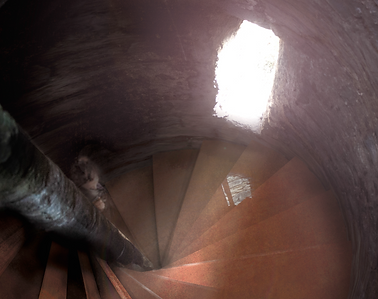
A CORTEN PATH guides visitors along this journey, becoming at times the WALL, a GANTRY, a CANOPY, or a STAIRCASE.
Designing and detailing these moments consequently informed the broader design language. Tectonics thus unites and details the journey through both the workshop and the inhabitation of the ruin.


SUSPENDED CORTEN // CARVING

EXPLORING CORTEN CUTS & LIGHTING THROUGH MODELS // ACROSS THE SCALES


PROGRESSION FROM CARVED SPACE TO FRAMED VISTAS

MODELLING // DEVELOPMENT


