
The word dementia describes a set of symptoms that may include memory loss and difficulties with thinking, problem-solving or language. These changes are often small to start with, but they can become severe enough to affect daily life. Dementia is caused when the brain is damaged by diseases, such as Alzheimer’s disease of a series of strokes. The specific symptoms that someone with dementia experiences will depend on the parts of the brain that are damaged. Each person is unique and will experience dementia differently. How others respond to the person, and how supportive or enabling the person’s surroundings are can also greatly affect how well someone can live with dementia.
The MMP studio intends to reinforce the broad responsibility of architecture to people, environment and society, and encourages proposals which are a response to the natural and cultural forces of a place. Siting these forces of place within the city of Copenhagen, conceptual concerns specifically related to site themes and context can be investigated.
Providing a vast community garden, with a productive purpose, within the district of Norrebro has the potential to offer members of the community of all ages, nationalities and abilities to actively or passively engage in a dynamic process. But alone, a productive landscape would not be enough.
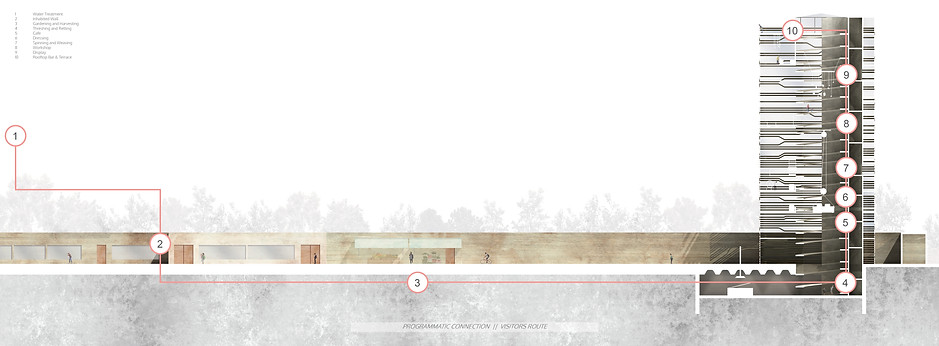
We propose a Linen Production Visitor’s Centre, facilitated by the produce grown in the garden, and run by the community themselves. Within the centre itself, which would be fully accessible, there would be countless opportunities for engagement and observation, with workshops running daily and safe, comfortable environments designed to provide desirable spaces to spend time in for all generations.
Within this proposal, education will play a pivotal role. Not only will local residents be able to learn new things about the linen production processes, but they will also be able to teach younger residents skills when it comes to gardening and design workshops. Collaboration will be key.

LINEN AND LIVING
MArch I || Research Project as a part of Mobility, Mood Place
[IN COLLABORATION WITH AMY WOOTTON]
GARDEN PROPOSALS // ACTIVE AND PASSIVE
Development at both an architectural and technical level built upon the initial proposition for a linen production centre within the empty & underused parkland. The design process sought to use all scales to emphasise the journey through the process of linen production, celebrated through a vibrant site with a community garden playing a key role.
The community gardens will afford local residents the opportunity to play an active role in the first process of linen production - the growing of the flax for linen, and the flowers and produce for dye.The site is split into four seasonal gardens, meaning that at all times of the year engagement in the gardening will be required. If visitors are not able to actively take part in caring for the crops, they have the opportunity to engage passively by simply sitting and watching the activities taking place.


TOWER AS LANDMARK
EVOKING MEMORY THROUGH BUILT DESIGN


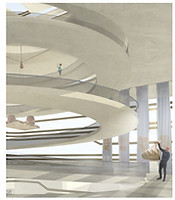
Memory loss is a symptom of dementia. Often the short-term memory is the worst affected, with longterm memory commonly remaining functional until the much later stages of dementia. If we are able to help people with dementia to trigger memories from many years ago, in some cases we may be able to enhance their sense of place, and orientation in space and time.
By proposing a Linen Production Visitor’s Centre in Nørrebro, a neighbourhood traditionally known for the manufacturing of many types of produce from chocolate to steel, we aim to evoke memory of the history of manufacturing in local area. Key access point to the Community Garden and Visitor’s Centre encourage visitors to reach the site by walking past various historic factory buildings, many of which remain unchanged on the outside. A literal interpretation of the ‘trip down memory lane.’

If visitors decide to arrive at the site via the newly planned Metro stop adjacent to the entry plaza, the theme of memory will perpetuated through the planning of the community gardens, which will contain plants that flower at different times of the year, evoking ideas of seasonal change as well as assisting to a point with orientation in time and place.

EXHIBITION


